The Quran devotes more words to Maryam (AS) than the entire Gospel of Mark devotes to Jesus. An entire chapter bears her name. She is explicitly named as one of the four greatest women in history. Allah Himself declares that she “guarded her chastity” (ahsanat farjaha), and He condemns those who slandered her.
So when Mirza Ghulam Ahmad (MGA), the founder of the Ahmadiyya movement, constructed an entire alternative narrative around her pregnancy, her marriage, and her character — one that surrounds her with suspicion and shame — the source of that narrative is the first and most urgent question to ask.
The answer is not the Quran. The answer is not the Sunnah.
The answer is Jewish apocryphal literature — a tradition produced by the very people the Quran condemns, in 4:156-157, for slandering Maryam (AS) in the first place.
The Quranic Account: The Standard Against Which Everything Is Measured
The Quran’s account of the birth of Isa (AS) is direct, detailed, and free of scandal.
The announcement is given in a waking state, by an angel:
“Idh qaalat al-malaa’ikatu yaa Maryamu innallaaha yubash-shiruki bi-kalimatin minhu ismuhu al-Maseehu ‘Isaa ibnu Maryama.”
“When the angels said: ‘O Maryam, indeed Allah gives you good tidings of a Word from Him, whose name will be the Messiah, Isa, the son of Maryam.’” — Quran 3:45
And in Surah Maryam, the angel visits her physically — he “represented himself to her as a well-proportioned man” (19:17). She was in seclusion, alone, separated from her people by a screen. This is not a dream.
She questioned it — and was answered directly:
“Qaalat rabbi annaa yakoonu lee waladun wa-lam yamsasnee basharun wa-lam aku baghiyya.”
“She said: ‘My Lord, how will I have a child when no man has touched me, and I have not been unchaste?’” — Quran 19:20
The Quran confirms the miracle with a direct comparison to the creation of Adam:
“Inna mathala ‘Isaa ‘indallaahi ka-mathali Aadama, khalaqahu min turaabin thumma qaala lahu kun fa-yakoonu.”
“Indeed, the example of Isa to Allah is like the example of Adam. He created him from dust, then said to him: ‘Be’ — and he was.” — Quran 3:59
She was under the guardianship of Zakariyya (AS):
The Quran is explicit that Maryam (AS) was in the care of Zakariyya (AS), who personally witnessed miraculous provision in her quarters (3:37). He is her closest custodian and guardian. There is no mention of Joseph.
Isa (AS) spoke from the cradle, as a child, to defend his mother:
“Fa-asharat ilayhi, qaalu kayfa nukallimu man kaana fi-l-mahdi sabiyya. Qaala innee ‘abdu Allaahi…”
“So she pointed to him. They said: ‘How can we speak to one who is in the cradle, a child?’ He [Isa] said: ‘Indeed I am the servant of Allah…’” — Quran 19:29-30
The Quran protects her honour explicitly:
“…wa bi-kufrihim wa qawlihim ‘alaa Maryama buhataanan ‘azeemaa.”
“And [We cursed them] for their disbelief and their saying against Maryam a great slander.” — Quran 4:156
The Quran declares that slandering Maryam (AS) is itself a mark of disbelief. This is the standard.
Now let us examine what MGA wrote.
The Primary Features of the Ahmadiyya Narrative
The Ahmadiyya narrative on Maryam (AS) was documented and systematically analysed by researchers studying MGA’s primary texts. The following points are the ones directly supported by the RK page images attached at the end of this article:
- MGA offers a naturalistic explanation of Maryam’s pregnancy rather than treating it as a unique miracle Ref
- He says the elders of the community married Maryam to Yusuf the carpenter Ref
- He says a son was born to her one or two months after she went to Yusuf’s house Ref
- He presents the marriage as driven by suspicion surrounding the pregnancy Ref
- He raises the objection that Maryam had already been dedicated to the service of Bayt al-Maqdis Ref
- He says marriage in a state of pregnancy would have been contrary to the Torah Ref
- He says Yusuf was unhappy with the marriage and already had a first wife Ref
- He explicitly uses Maryam’s movement with her fiance Yusuf before nikah as evidence in an Israelite-custom argument Ref
- In that same comparison, he says some tribes treat pre-marital pregnancy as socially tolerable Ref
This is the Ahmadiyya version of the birth of the Messiah.
Where This Narrative Comes From
The most important question: what is the source?
The researchers who documented this narrative identified it clearly:
“This entire narrative is based on extra-biblical, unknown Jewish literature. It is not even biblical. It is extra-biblical, from unknown sources, and they are Jewish sources.”
It is not in the Quran. It is not in any authenticated hadith. It is not in the Bible. It comes from Jewish apocryphal traditions — the very traditions produced by those whose rejection of Isa (AS) began with questioning his birth.
The bitter irony is that the Quran explicitly condemns the Jews for this slander. Surah An-Nisa (4:156-157) identifies their “saying against Maryam a great slander” as a sign of their disbelief. Yet MGA’s narrative is built on the traditions of the same slanderers — incorporating their doubts about her chastity and their suspicions.
The people whose literature MGA used to construct this narrative are, according to the Quran, the culprits. They are biased by definition. They are the ones who rejected the Virgin Birth. And now they are MGA’s primary source.
The Specific Evidence: What MGA Actually Wrote
On the Virgin Birth: The “Hermaphrodite” Theory
MGA offered a naturalistic explanation for how Maryam (AS) could have become pregnant. In Ruhani Khazain, Vol. 23, p. 226, he wrote — citing “accomplished physicians” and “books of Hindus” as his sources:
“There are certain women who have both qualities — male and female — they have both characteristics. And by some action or movement, when their sperm becomes excited, it can cause a pregnancy to take place.”
He used this claim to suggest that Maryam (AS) was a woman with both masculine and feminine biological characteristics who became pregnant through an internal biological process.
Several things must be noted about this statement:
-
It contradicts the Quran directly. Quran 3:59 compares the birth of Isa to the creation of Adam — a miracle. Quran 19:20-21 records Maryam’s own bewilderment at the announcement and the angel’s reply that this is a decree of Allah. The phrase bi-idhniLlah (by the permission of Allah) in 3:49 makes the divine agency explicit.
-
It endorses the Jewish position. The Jewish rejection of the Virgin Birth is the very slander the Quran condemns in 4:156-157. MGA is here providing a pseudo-medical framework that serves the same function as the Jewish rejection — naturalising what the Quran calls a direct act of Allah.
-
Its sources are physicians and Hindu texts. MGA cites human medical literature and Hindu scriptures as his evidential basis for explaining the birth of a prophet of Allah.
-
It has no scientific basis. The medical phenomenon described — a woman with “both male and female characteristics” producing fertile sperm internally through “excitement” — does not exist.
On the Marriage and Suspicion Narrative
In Ruhani Khazain, Vol. 20, pp. 355-356, MGA writes:
“The elders of the community married Maryam to a carpenter named Yusuf, and one or two months after she went to his house, a son was born to her.”
On the same page set he also says:
“In short, Maryam’s marriage took place merely because of suspicion. Otherwise, what need was there to marry a woman who had already been dedicated to the service of Bayt al-Maqdis?”
The same discussion goes on to treat the pregnancy as the reason the elders acted, and to raise further objections about the temple vow, the Torah’s rules, and Yusuf’s prior marriage. That is the core problem: the narrative builds around communal suspicion and social management, whereas the Quran presents Maryam (AS) as divinely vindicated and protected.
On the Afghan Women Analogy
In Ruhani Khazain, Vol. 14, p. 326, MGA was arguing that the Afghan people are descendants of the lost tribes of Israel. One of the similarities he drew was social custom:
He says women in some tribes mix freely with their fiancees, that Maryam’s moving about with her fiance Yusuf before marriage is proof of the same Israelite custom, and that in some cases pregnancy occurs before nikah.
The scholars presenting these references described it plainly:
“What Mah is doing here is exactly what the Talmud did to Isa Alam… there are accusations of unchastity against Maryam in the Israelite literature to this day — in the Babylonian Talmud… This is why Allah defends Maryam in the Quran. And Mah here is repeating those accusations, endorsing them.”
The Quranic Proofs Against Each Point of the Narrative
Zakaria (AS), Not Joseph, Was Her Guardian
The Quran explicitly states that Maryam was under the kafaalah (guardianship) of Zakariyya (AS) — 3:37. Whenever Zakariyya entered her quarters he found miraculous provision. He is her family, her guardian, and the person immediately connected to her situation. Joseph does not appear anywhere in the Quran’s account of the birth of Isa (AS).
The Quranic Linguistic Proof of the Virgin Birth
The Quran’s own language provides one of the most elegant and unambiguous proofs of the Virgin Birth. In the same Surah (Maryam, Chapter 19), two prophets are described in adjacent passages:
About Yahya (AS):
“Wa barran bi-walidayhi wa-lam yakun jabbaaran ‘asiyyaa.”
“And dutiful to his parents (walidayhi — plural, both parents), and he was not a disobedient tyrant.” — Quran 19:14
About Isa (AS):
“Wa barran bi-waalidatee wa-lam yaj’alnee jabbaaran shaqiyyaa.”
“And dutiful to my mother (waalidatee — singular, the mother alone), and He has not made me a wretched tyrant.” — Quran 19:32
In the same Surah, in parallel grammatical structures, describing two prophets in similar terms, the Quran uses walidayhi (both parents) for Yahya and waalidatee (my mother alone) for Isa.
The Quran is telling you directly, in its own language, that Isa has only one parent. He says “my mother” — singular — because he has no father.
MGA’s entire narrative — with its carpenter and its arranged marriage — creates a framework in which Isa (AS) does have a biological father in all but legal acknowledgment. This contradicts the Quran’s own testimony in the most direct way possible.
The Cradle Speech Is in the Quran
Quran 3:46 says Isa will speak “fi-l-mahdi” (in the cradle) and “wa kahlan” (as a mature man). The Arabic mahd means a cradle — the place where an infant lies. It is not a metaphor for youth. The Quran distinguishes it from kahl (a grown man in his thirties to fifties) as two separate, distinct stages.
Quran 19:29-30 records the people asking: “How can we speak to one who is in the cradle, a child (sabiyya)?” — and Isa answers them. The Quran uses the word sabiyya (a small child, an infant). The response is given in the cradle, as a child.
Every classical Tafsir from the Sahaba forward affirms this. Denying the cradle speech as an infant miracle means rejecting the plain text of the Quran.
The Devastating Structural Problem
The Ahmadiyya narrative does not merely introduce extra details. It fundamentally changes the meaning and purpose of Maryam’s story in the Quran.
In the Quran, the story of Maryam (AS) is a story of divine selection, miraculous intervention, and vindication. Allah chose her. He sent an angel to her. He miraculously made her pregnant. When people questioned her, her infant son spoke from the cradle to vindicate her before they could even ask the question. Her honour was protected immediately, miraculously, by Allah Himself.
In MGA’s version, the story is one of suspicion, human arrangement, and social management. Elders intervene. Joseph is inserted into the story. Marriage becomes the response to communal doubt. The birth is discussed through human custom and biological theory rather than through direct divine vindication.
The Quranic story glorifies Allah’s direct protection of Maryam. The Ahmadiyya story shifts the focus to human arrangement and communal suspicion.
These are not the same story.
Why This Narrative Was Theologically Necessary for MGA
The strategic logic parallels what drove MGA’s denial of the miracles of Isa (AS).
MGA claimed to be the Promised Messiah — the second coming of Isa (AS). If the first coming arrived with a miraculous birth authenticated by angelic announcement, divine protection, and a Quranic chapter bearing his mother’s name, then comparisons to MGA — born in the conventional manner in Qadian, Punjab, to a mortal father — become uncomfortable.
But if the first coming of the Messiah was reframed through scandal, suspicion, and a hasty arranged marriage, then the absence of similar divine grandeur in MGA’s own origins becomes unremarkable.
The degradation of the first coming serves the elevation of the second.
The Source of the Slander
It is worth pausing on this point.
The Quran condemns a specific group of people for a specific act: slandering Maryam (AS). The verse is 4:156-157:
“Wa bi-kufrihim wa qawlihim ‘alaa Maryama buhataanan ‘azeemaa.”
“And for their disbelief and their saying against Maryam a great slander (buhtaanan ‘azeema).”
The word buhtaan means a lie so severe that the person accused is left stunned and speechless. The Quran uses the emphatic form (buhtaanan ‘azeemaa — a great slander) to describe what was said about Maryam by those who rejected Isa (AS).
MGA’s primary source for his narrative is the extra-biblical literature of this same group. He goes to the Talmudic tradition — the tradition of those whose buhtaan the Quran condemns — to construct his account of the birth of the Messiah.
And he ends up producing an account that functions as a buhtaan: one that clouds the Virgin Birth, introduces suspicion about her chastity, and provides naturalistic explanations for her pregnancy.
The Islamic Position
The Islamic position on Maryam (AS) and the birth of Isa (AS) is clear, consistent, and sourced entirely from the Quran and mutawatir tradition:
- The Angel Jibril (AS) appeared to Maryam (AS) in a waking state, in physical form
- She was a virgin and had never been touched by a man
- Allah breathed His spirit into her through the angel (nafakhna feehi min roohina, 21:91)
- She was under the guardianship of Zakariyya (AS), not Joseph
- She “guarded her chastity” — the Quran’s own words
- When she returned with the child, people questioned her
- Isa (AS) spoke from the cradle (fi-l-mahd) as an infant (sabiyya) to testify to her purity — immediate, miraculous, divine vindication
- Allah Himself calls those who slandered her disbelievers (kaafiroon)
- The Quran names Isa as “Ibn Maryam” — the son of Maryam — not “ibn Yusuf”
The Ahmadiyya narrative contradicts points 1, 3, 4, 5, 6, 7, and 9. It endorses the position condemned in point 8.
What the Quran Says Is the First and Last Word
When a Muslim is presented with MGA’s extra-biblical Jewish apocryphal narrative on one side, and the Quran’s testimony on the other, the choice is straightforward.
The Quran calls Maryam (AS) siddeeqa — truthful, pure, verified by God. It calls her the chosen one above all women of the worlds. It names her son directly, in context, as born of miraculous divine intervention. It condemns those who claimed otherwise.
MGA’s narrative clouds the miracle with suspicion and naturalistic explanation. The Quran records divine intervention and vindication as fact.
One of these positions is correct. They cannot both be.
Ahsanat farjaha — “She guarded her chastity.”
This is Allah’s testimony about Maryam (AS). No extra-biblical Jewish apocrypha, no pseudo-medical theory about biological hermaphroditism, and no Qadiani alternative narrative can change that.
Primary References for the Source-Backed Claims
- [Ruhani Khazain, Vol. 20, pp. 355-356]. This is the main page-image evidence for Joseph’s insertion into the story and for the claim that Isa (AS) was born one or two months after Maryam went to Yusuf’s house. In the local RK corpus and page-image set, this cited discussion appears on scan page 394 of the volume.
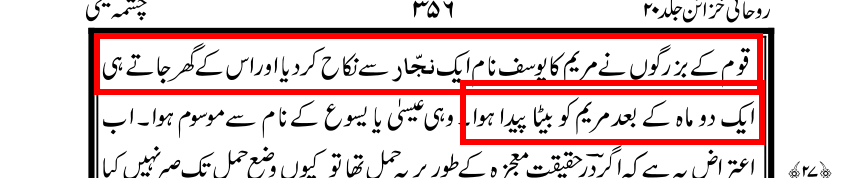
English translation:
“The elders of the community married Maryam to a carpenter named Yusuf, and one or two months after she went to his house, a son was born to her.”
2. [Ruhani Khazain, Vol. 20, p. 356]. This page contains the sharpest wording on suspicion: the marriage is presented as a response to suspicion, and the prior vow of temple service is used to question why the marriage happened at all. In the local RK corpus and page-image set, this cited discussion also appears on scan page 394 of the volume.
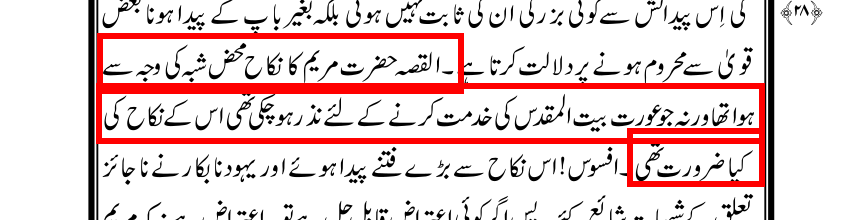
English translation:
“In short, Maryam’s marriage took place merely because of suspicion. Otherwise, what need was there to marry a woman who had already been dedicated to the service of Bayt al-Maqdis?”
3. [Ruhani Khazain, Vol. 14, p. 326]. MGA explicitly places Maryam and Yusuf into an Israelite social-custom argument, saying Maryam moved about with her fiance Yusuf before marriage and comparing that to Afghan custom, including cases where pregnancy occurs before marriage.

English translation:
“Women meet and speak freely with their fiancees. Maryam the truthful one’s moving about with her fiance Yusuf before marriage is firm evidence of this Israelite custom. In some tribes this similarity goes so far that sometimes pregnancy occurs even before nikah.”
4. [Ruhani Khazain, Vol. 23, p. 226]. This is the primary source for MGA’s naturalistic explanation of the virgin birth: he cites earlier physicians and Hindu materials and says some women combine male and female powers such that pregnancy may occur internally.
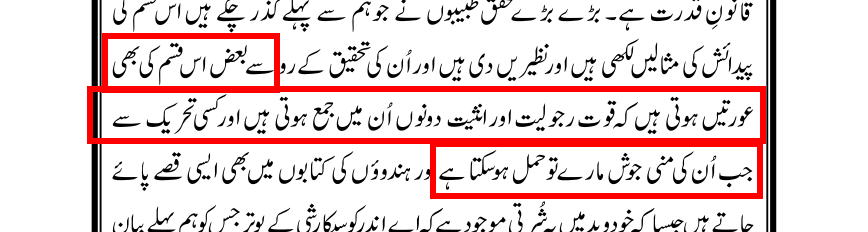
English translation:
“There are some women in whom both masculine and feminine powers are combined, and when, through some stimulation, their semen is stirred, pregnancy can occur.”
About the author — Staff Writer
Researcher in Ahmadiyya primary sources, focusing on claims, prophecies, and internal contradictions documented in Ruhani Khazain.
Related Articles
The Prophet Islam Honours, the 'Messiah' Who Attacked Him: MGA's Campaign Against Isa (AS)
By Staff Writer
Read More →
MGA's Ilzami Jawab: Eight Rules He Set, Eight Rules He Broke
By Staff Writer
Read More →
The Three Methods: How MGA Systematically Dismantled the Miracles of Isa (AS) -- and the Prophet ﷺ
By Staff Writer
Read More →